
PBR Panel vs. AG Panel: Which Profile Belongs on Your Building
Updated: Sep 15
Two ribbed steel panels. Both exposed fasteners. Both go on roofs and walls. From forty feet away on a finished building, a lot of people couldn't tell you which is which.
Up close, they're built for different structural jobs—and once you understand what the rib is doing, the specification decision gets simple.
What The Rib Is For
The rib isn't decoration. A flat sheet of steel spanning between supports deflects under load. Form a rib into it, and you dramatically increase its stiffness in the direction of the span. Deeper ribs, more stiffness, longer spans, and more load.
That's the entire story, and the two profiles sit at different points on it.

AG Panel: The General-purpose Workhorse
The AG Panel is Metal Wholesale's flagship roofing and siding panel, and it earns that position by being the right answer most of the time.
3/4" rib profile, 36" coverage
Grade 80 steel, 29 or 26 gauge
Cut to order
Up to 2' on-center roof spacing
Full spectrum of smooth and textured colors in 29 gauge; 10 colors in 26 gauge
Optional Smooth Liner, Perforated Liner, and Zero Drip Condensation Control
UL 2218 Class 4 impact, UL 580 Class 90 wind uplift, UL 790 Class A fire
The 3/4" rib is the sweet spot for residential, agricultural, and general commercial work. Wide 36" coverage means fewer panels and faster installation. And the AG Panel line carries the accessory ecosystem—liners, Zero Drip, and the full color palette—which matters more than builders expect once a building has an interior.
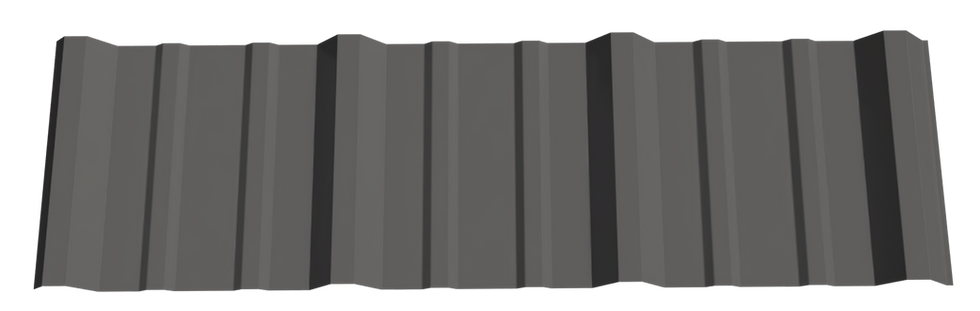
PBR Panel: Built To Span and Carry
The Prefabricated PBR Panel is a different structural proposition.
Deep rib profile with a purlin-bearing rib design
Heavy-duty 26-gauge steel
Available in 18 smooth colors
Color matched to the other Metal Wholesale panel profiles
Fast and easy to install
The critical feature is in the name. The purlin-bearing rib sits directly on the structural framing. That changes how load transfers out of the panel and into the building — the rib bears on the purlin rather than the panel flat carrying that duty, which delivers enhanced load-bearing capability and superior spanning performance.
For roofing and wall applications on commercial and industrial buildings, where framing may be spaced further apart and design loads run higher, that's exactly what you want.
The Practical Difference
Rib depth. PBR's deeper profile is doing more structural work. Where framing spacing or load conditions push past what a 3/4" rib comfortably handles, the deeper profile is the answer.
Load path. The purlin-bearing rib design transfers load into framing more directly. That's the differentiator, and it's why PBR shows up on metal building systems and industrial structures.
Color availability. AG Panel in 29 gauge carries the full smooth and textured range. PBR runs 18 smooth colors, color-matched to your other profiles — which means you can run PBR on a shop roof and AG Panel on the attached office and have them match.
Accessories. Liners and Zero Drip are AG Panel–line features. If the building needs condensation control on the panel or a finished interior liner, factor that into the profile decision early, not after the order.
Spec PBR When
Commercial or industrial structures with real design loads
Framing spacing that a 3/4" rib profile doesn't comfortably serve
Metal building systems where PBR is the expected profile and the details are drawn for it
Higher snow or wind loads that call for more panel stiffness
You want the heavier 26-gauge product across the whole roof
Spec AG Panel When
Residential, agricultural, and general commercial — the majority of buildings
Framing at conventional spacing, up to 2' on center for roofing
Color is part of the brief — the textured palette lives here
The interior gets finished, or the building needs Zero Drip or acoustic liner
Cost and installed speed matter, and 36" coverage moves square footage faster
Don't Guess This One
Panel spanning is a structural question, not a preference. Actual capacity depends on gauge, span, framing configuration, and the design loads for your location — snow, wind, and whatever else your building code brings.
Get the load table and check it against the real conditions on the project. If a building department is reviewing it, they'll want to see that work anyway.
Metal Wholesale provides takeoff assistance to dealer partners, which is the right place to resolve this before it becomes a quote.
Running Both On One Project
Worth knowing: you don't have to choose one for the entire site.
Because PBR is color-matched to the other Metal Wholesale profiles, a project can run PBR where spanning demands it and AG Panel where it doesn't—the main shop in PBR, the attached office and outbuildings in AG Panel, Metal Batten on a feature wall—and the whole property reads as one coordinated build.
That flexibility is the practical advantage of buying the profiles from one manufacturer, and it's a strong reason to keep both in your yard.
Frequently Asked Questions (FAQs)
What is the primary difference between an AG Panel and a PBR Panel?
The key distinction lies in rib profile and structural load-bearing capability. An AG panel utilizes a standard $3/4\text{''}$ rib profile suited for general residential and agricultural applications. A PBR (Purlin-Bearing Rib) panel features a deeper $1\text{-}1/2\text{''}$ profile with an extended bearing leg that sits directly on structural purlins to transfer heavy loads efficiently.
Why is a purlin-bearing leg important for commercial or industrial framing?
The purlin-bearing leg provides direct structural support under the panel overlap. This prevents the panel rib from crushing during installation or heavy snow and wind loads, allowing for wider framing spans typically required in commercial and industrial metal buildings.
Can AG Panels and PBR Panels be used together on the same property?
Yes. Because PBR panels can be color-matched to AG panel profiles, you can install PBR panels where higher structural performance is required (such as a large workshop) and use AG panels on adjacent structures (like an office or attached garage) while maintaining a uniform appearance.
Which metal panel profile supports condensation control or interior liners?
The AG Panel product line offers integrated options such as Zero Drip Condensation Control, Smooth Liners, and Perforated Acoustic Liners. If your building project requires condensation management or a finished interior ceiling/wall liner, factor these AG Panel features into your initial design.
How do I determine whether my project requires AG Panel or PBR Panel?
Panel selection depends on your building’s structural design, framing spacing (on-center distance), gauge preference, and local design loads for wind or snow. For framing spaced up to 2 feet on-center, AG panels are standard; for wider purlin spacing or heavier commercial load requirements, PBR panels should be specified based on manufacturer load tables.


Comments