
Metal Roof Installation Cost: Contractors' Estimating Guide

Installed metal roofing costs vary significantly depending on system type, with most residential steel projects falling into a moderate price range. The single biggest cost driver is labor, which represents a substantial portion of total installed cost on most jobs. Use the sample estimator in Section 6 to convert these per-square-foot figures into a project total your crew can bid against.
Key figures at a glance:
Installed range varies from lower-cost exposed-fastener panels to more expensive standing seam and specialty metals
Labor share constitutes a significant fraction of total installed cost
Hidden-cost inflation: 10%–30% above baseline for high-performance systems
Table of Contents
What drives metal roof installation cost?
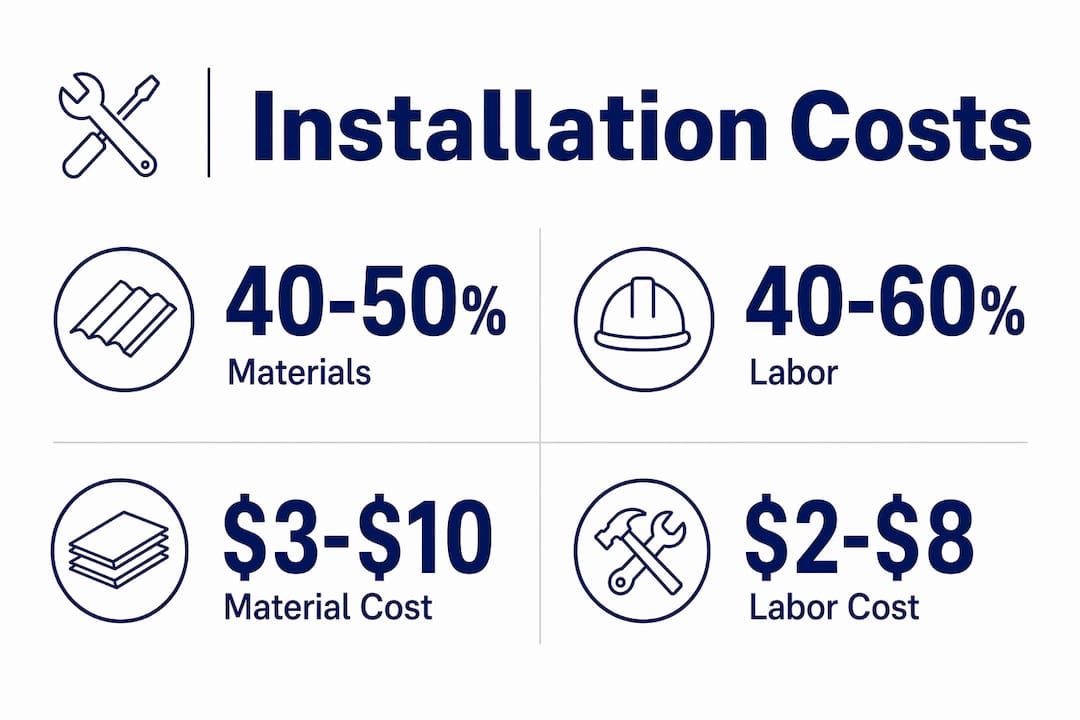
Understanding the full cost breakdown is what separates a tight bid from a money-losing job. Materials and labor roughly equally contribute to total costs on average, but system complexity can shift this ratio.
Cost Component | Typical Share | Per-Sq-Ft Range |
Materials (panels, trim, fasteners) | 40%–50% | $3.50–$16 |
Labor (install, seaming, flashing) | 40%–60% | $4–$16 |
Tear-off / disposal | 5%–10% | $1–$3 |
Permits and inspections | 2%–5% | $0.50–$1.00 |
Staging / equipment rental | 2%–5% | $0.50–$1.00 |
Note: The per-square-foot labor cost figure is harmonized with the stated installed cost ranges elsewhere in the article and with industry cost breakdowns showing labor frequently runs $5–$16/sq ft within total installed cost brackets. The labor share (40%–60%) stands; the per-sq-ft labor line is updated, as $1–$3/sq ft cannot match the total installed ranges and sample labor bid values given throughout.
Labor runs $400–$800 per square (100 sq ft) for metal installation, compared to $200–$350 per square for asphalt shingles. This equates to $4–$8 per sq ft for labor on typical metal projects, aligning with the larger labor share of total installed cost. That gap is the first thing to communicate to customers pushing back on metal pricing.
Non-material line items to include in every bid:
Permit fees (vary by municipality; budget $200–$800 for most residential jobs)
Tear-off and haul-away: $1–$3/sq ft when removing an existing roof
Scaffolding or staging rental for steep or multi-story work
Safety equipment and insurance surcharges for complex geometry
Quick arithmetic example: For example, a typical mid-range standing seam roof installation on a 2,000 sq ft home may result in substantial total costs including materials, labor, tear-off, and permits.
How panel type and coatings shift your material spend
The choice of panel profile greatly influences the project’s material costs.
Exposed-fastener panels (corrugated, R-panel): $3.50–$6/sq ft installed. Fastest to install, lowest labor hours, best fit for agricultural and light commercial.
Batten panel profile: Mid-range pricing with a cleaner aesthetic; popular for residential and light commercial where curb appeal matters.
Standing seam: $7–$14/sq ft installed for steel; $9–$16 for aluminum. Hidden clips and precision seaming push labor hours up by 50%+ versus exposed-fastener on the same footprint.
Stamped metal shingles: More complex manufacturing and installation; expect a premium over standard standing seam.
Specialty metals (zinc, copper): $12–$40+/sq ft. Copper carries a 70–100+ year lifespan but commands the highest material and labor cost.
Gauge and finish matter for resale positioning. Thicker gauges (26 vs. 29) resist denting and hold paint systems longer. PVDF/Kynar coatings carry longer finish warranties than SMP systems and justify a higher resale price to end customers. Accessories add up fast: ridge caps, closures, flashings, and specialty fasteners can represent 10%–15% of total material spend on a well-spec’d job.
Pro Tip: Upsell PVDF/Kynar coatings on residential and coastal jobs where the customer plans to stay 15+ years. For commodity agricultural bids where first cost wins, SMP on a 26-gauge panel is usually the right call.
Common add-ons that inflate quotes after work starts
High-performance systems add 10%–30% beyond baseline quotes when hidden costs surface mid-job. Budget for them upfront.
High-temp underlayment: Required under most standing seam systems; costs more than standard synthetic felt.
Ice-and-water shield: Mandatory in cold climates at eaves and valleys; add $0.50–$1.00/sq ft for coverage areas.
Complex flashing: Chimneys, skylights, and dormers add $200–$500 each in labor and material.
Specialty fasteners: Concealed-clip systems and wind-rated fasteners cost more per unit than standard exposed screws.
Custom field-formed trim: Non-standard eave, rake, or valley profiles require shop time or field bending.
Unforeseen decking repairs: Damaged sheathing adds $50–$100 per sheet replaced.
For small jobs (under 15 squares), build in a 10%–15% contingency. On larger or complex jobs, 15%–20% is more realistic. Steep roof pitches frequently cause increases in installation costs because of added safety requirements and reduced crew speed.
How labor hours and regional rates affect your bid
Crew productivity varies significantly by system type and roof geometry.
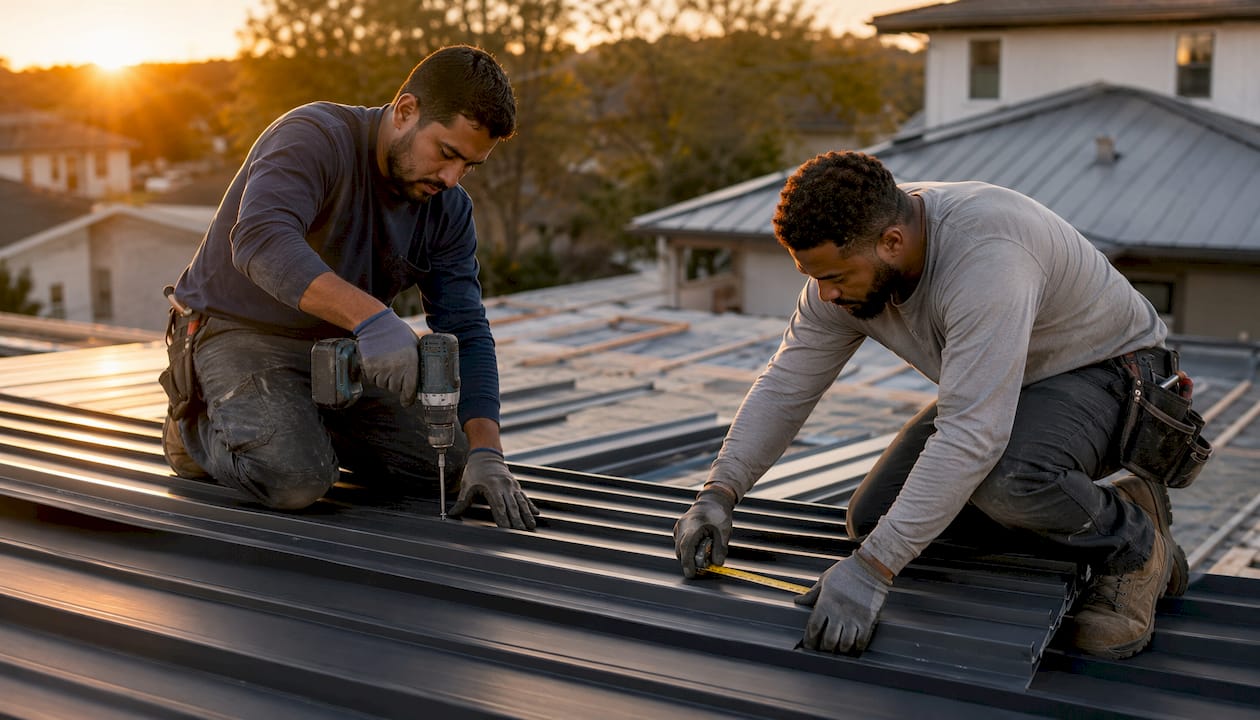
System Type | Crew Productivity (sq ft/crew-day) | Labor Cost/Square |
Exposed-fastener panels | 1,500 | $400–$600 |
Standing seam | 800 | $600–$800 |
Complex geometry / steep pitch | 500 | Add 10%–30% surcharge |
Standing seam requires hidden clips, precise chalk lines, and careful seaming. A 1,500 sq ft standing seam install typically needs three installers over two to three days. Exposed-fastener panels on a simple gable can move twice as fast.
Regional variations can cause significant deviation from national average roofing costs. Urban Northeast markets and coastal regions sit at the high end; rural South and Midwest markets typically run lower. For current local wage data, check the Bureau of Labor Statistics Occupational Employment and Wage Statistics (OEWS) for roofing contractors in your state, or pull recent bids from your own crew history.
Steep-pitch surcharges (10%–30%) cover safety harnesses, slower panel handling, and additional staging time.
Penetrations (chimneys, vents, skylights) add labor hours regardless of system type.
Midwest regional pricing tends to run below coastal averages, which affects both your material sourcing and your labor estimates.
Step-by-step sample installed-cost estimate
Use this formula on every bid: Total installed cost = (materials + accessories + labor + equipment + permits + disposal) × (1 + contingency%)
Worked example: 2,000 sq ft residential standing seam
Convert to squares: 2,000 sq ft ÷ 100 = 20 squares
Add 10% waste factor: 22 squares of panel material
Material cost at $700/square: 22 × $700 = $15,400
Accessories (trim, fasteners, sealant, underlayment): ~15% of material = $2,310
Labor at $600/square (installed): 20 × $600 = $12,000
Tear-off: 20 squares × $200 = $4,000
Permits: $500
Subtotal: $34,210
Apply 15% contingency: $34,210 × 1.15 = $39,342 total
These figures assume a labor rate of $6/sq ft, matching the $600/square figure and aligning with typical labor shares reported nationally.
Roof square footage and pitch
Number of penetrations (chimneys, vents, skylights)
Existing roof condition and layer count
Panel profile and gauge specified
Local permit requirements
Delivery address and site access for staging
Line Item | Formula | Sample Value |
Panel material | Squares × unit cost | $15,400 |
Accessories | Material × 15% | $2,310 |
Labor | Squares × labor rate | $12,000 |
Tear-off | Squares × $200 | $4,000 |
Permits | Fixed | $500 |
Contingency (15%) | Subtotal × 0.10–0.15 | — |
Total | $39,342 |
How wholesale buyers reduce cost and avoid delays
Procurement decisions made before the job starts determine whether you hit your margin or chase overruns.
Volume and bundling tactics:
Order panels, trim, fasteners, and sealant together to qualify for bundled pricing.
Specify exact trim packages upfront. Missing trim specs are the leading cause of mid-job change orders and cost overruns.
Confirm minimum order quantities with your supplier before finalizing bid quantities.
Logistics checklist:
Schedule delivery windows that align with crew start dates, not just material availability.
Confirm site access for flatbed or boom delivery before the truck arrives.
Store panels flat, off the ground, covered, and away from foot traffic.
Use same-day pickup options when a job runs short on trim or accessories.
Verify fastener specs (length, coating, thread type) match your panel profile before ordering.
Providing complete underlayment and trim specifications with your initial order prevents the most common source of scope creep. A missing F-channel or closure strip discovered on install day costs far more in crew downtime than the part itself.
How to mark up quotes and protect your margin
Markup strategy depends on job type, material cost, and labor variability.
Material resale markup:
Standard markup for panel and trim resale: 20%–35% over landed cost.
Premium systems (standing seam, PVDF finish): 30%–40% markup is defensible given longer lead times and tighter tolerances.
Fasteners and accessories: 40%–50% markup is common given low unit cost and high handling time.
Installation bid pricing:
Calculate your true labor cost (crew hours × fully-loaded rate including overhead).
Add material at cost plus markup.
Add contingency (10%–20% depending on complexity).
Compare your total per-square to market range ($600–$1,900/square installed) to confirm competitiveness.
Contract clauses to include:
Contingency percentage and what triggers a change order.
Change-order process: written approval required before additional work begins.
Deposit (typically 30%–40%) and progress-payment schedule tied to milestones.
Warranty pass-through language from manufacturer to end customer.
Installer qualifications and product checks that reduce callbacks
Callbacks are the fastest way to erase margin. Vet installers and materials before the job starts.
Installer proof points to request:
Manufacturer certification for the specific panel system being installed.
Portfolio of completed jobs with the same profile and complexity.
Workmanship warranty (minimum 2 years; 5 years is better for standing seam).
References from jobs completed in the past 12 months.
For guidance on choosing the right contractor for metal and post-frame work, verify that the crew has hands-on experience with hidden-clip systems before committing to a standing seam project.
Product trust signals to verify:
Finish warranty length (PVDF/Kynar systems typically carry 30–40 year paint warranties vs. shorter SMP coverage).
Panel gauge confirmed against order spec at delivery.
Warranty transferability if the end customer may sell the property.
Pro Tip: Inspect panel bundles at delivery before the crew starts. Check for coating damage, gauge consistency, and correct profile. Accepting damaged material and discovering it mid-install costs two to three times more to resolve than a delivery rejection.
Why metal roofing wins on lifetime cost
The upfront premium on metal is real, but the math over a building’s life usually favors it. Metal roofs typically last 40–70+ years versus 15–25 years for asphalt shingles, meaning a property owner may replace shingles two to three times before a metal roof needs replacement.
Roofing Type | Typical Lifespan | Replacement Cycles (50 yrs) | Relative Lifecycle Cost |
Asphalt shingles | 15–25 years | 2–3 replacements | Higher total spend |
Exposed-fastener metal | 30–40 years | 1–2 replacements | Moderate |
Standing seam steel | 40–70+ years | 0–1 replacement | Lowest long-term |
Copper / zinc | 70–100+ years | 0 replacements | Highest upfront, lowest lifecycle |
Value-selling bullets for contractor conversations with end customers:
Lower maintenance costs: no granule loss, no cracking, no moss treatment.
Energy efficiency gains from reflective coatings can reduce cooling loads in warm climates.
Insurance discounts in storm-prone regions for impact-rated metal panels.
Resale value: metal roofing is a recognized upgrade that buyers recognize at appraisal.
Compare the full cost picture against shingles before the customer decides on price alone.
Metalwholesale cuts your procurement time and installed cost
When lead times stretch and mid-job shortages kill productivity, your margin disappears before the last panel goes up. Metalwholesale manufactures and ships high-performance metal roofing panels, trim, and accessories with same-day pickup available, so your crew never waits on material.

The SKU set covers what installers actually run short on: metal roof sealant for flashing and trim work, batten panel profiles for mid- to high-end residential jobs, F-channel and F&J trim profiles for clean edge and closure work. Certified installer and dealer support means you get spec help before the order, not a call center after the job goes sideways. Contact Metalwholesale directly to get product pricing, confirm availability, and place your next bulk order.
Key Takeaways
Metal roof installation cost is controlled primarily by labor (40%–60% of total) and system complexity, not material price alone.
Point | Details |
Labor dominates total cost | Budget 40%–60% of installed cost for labor; crew productivity matters more than small material-price differences. |
Hidden costs add 10%–30% | Underlayment, flashing, specialty fasteners, and decking repairs routinely push final cost above baseline quotes. |
Tear-off adds $1–$3/sq ft | Always confirm existing roof condition and layer count before finalizing a bid. |
Trim specs prevent overruns | Provide complete trim and underlayment specs with every order to avoid mid-job change orders. |
Metalwholesale for fast supply | Same-day pickup and a full accessory SKU set (sealant, batten panel, F-channel, F&J) reduce staging delays. |
A contractor’s perspective on what this guide is really for
Most cost guides for metal roofing are written for homeowners deciding whether to upgrade. This one is written for the people who actually buy and install the material. The gap between a $10/sq ft bid and a $16/sq ft bid on the same standing seam job usually comes down to three things: how well the crew knows the system, how complete the trim package was at order, and whether the contingency was realistic. Get those three right and the margin holds. Miss any one of them and you’re eating the difference.
Metalwholesale exists to reduce the friction on the supply side. Fast delivery, correct specs, and a product line built for installers means fewer surprises between order and completion. If you want a custom quote or need to confirm product availability for an upcoming job, reach out directly through the Metalwholesale site.


Comments